
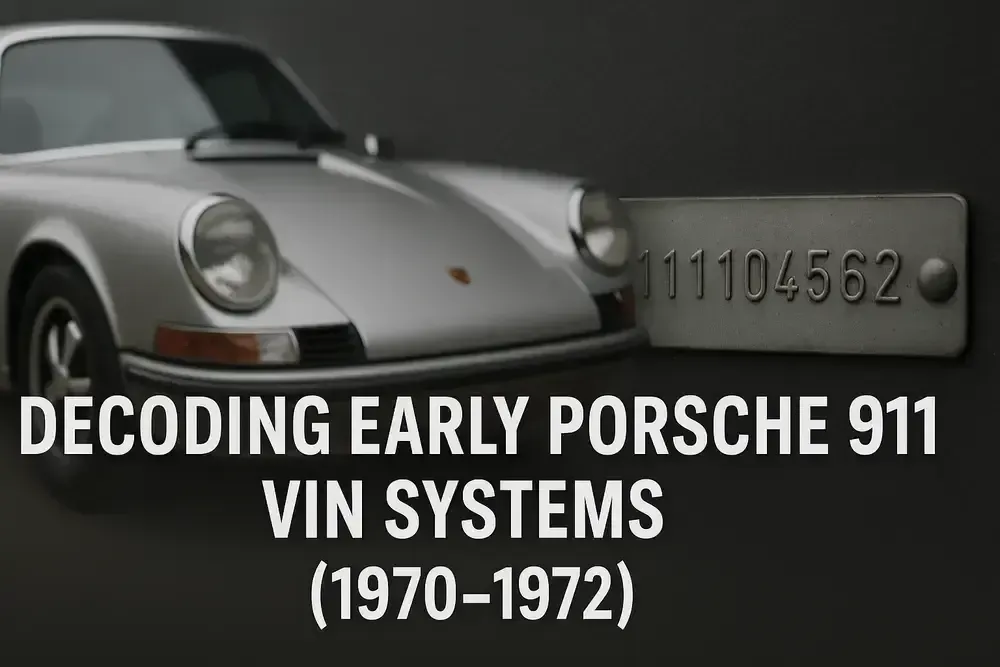
Decoding the DNA: A Comprehensive Guide to Early Porsche 911 VIN Systems (1970-1972)
Understanding the unique chassis numbering system that preceded modern VIN standardization
Introduction
Long before the 17-character Vehicle Identification Number (VIN) became the global standard in 1981, automotive manufacturers employed their own unique systems for identifying vehicles. Porsche, with its characteristic German precision, developed a sophisticated yet compact chassis numbering system for the iconic 911 series that tells a rich story about each vehicle's specifications, production sequence, and place in automotive history.
The early 1970s represent a pivotal period in Porsche 911 evolution, marked by the introduction of the larger 2.2-liter engine and significant chassis improvements. Understanding these early VIN systems—more accurately called chassis numbers—provides enthusiasts, collectors, and automotive professionals with crucial insights into vehicle authenticity, specifications, and historical significance.
This comprehensive guide examines the intricate world of early Porsche 911 chassis numbers from 1970-1972, exploring their structure, evolution, and the technical challenges involved in creating modern decoding systems for these classic vehicles.
Historical Context: The Pre-Standardization Era
The Automotive Landscape of 1970-1972
In 1970, the automotive industry operated in a vastly different regulatory environment. Vehicle identification systems were largely manufacturer-specific, with each company developing internal numbering schemes that served their production and record-keeping needs. The U.S. National Highway Traffic Safety Administration wouldn't mandate standardized VIN formats until 1981, leaving manufacturers free to implement their own solutions.
Porsche, as a relatively small manufacturer producing specialized sports cars, developed a remarkably efficient system that packed maximum information into minimal characters. The 10-character chassis number format used for the 911 series demonstrates the company's engineering philosophy: elegant simplicity achieving complex functionality.
The Significance of the 1970-1972 Period
These three model years represent a crucial evolutionary phase for the 911:
- 1970: Introduction of the longer wheelbase (increased by 57mm) and larger 2.2-liter engines
- 1971: Refinement of the 2.2-liter powerplants and continued development of fuel injection systems
- 1972: The final year of 2.2-liter engines before transitioning to 2.4-liter units, and introduction of more stringent emissions controls
Each year brought subtle but significant changes that are reflected in the chassis numbering system, making proper identification crucial for understanding a vehicle's specifications and historical context.
Understanding the Porsche 911 Chassis Number Structure
Basic Format Overview
Early Porsche 911 chassis numbers follow a precise 10-character format:
9 1 1 [Y] [V] [S] [S] [S] [S] [S]
│ │ │  │   │   └─────────────────── Serial Number (5 digits)
│ │ │  │   └────────────────────────── Variant Code (1 digit)
│ │ │  └────────────────────────────── Year Code (1 digit)
└─┴─┴───────────────────────────────── Model Prefix "911"
This compact system encodes essential information about model designation, production year, variant specifications, and individual vehicle sequence within remarkably few characters.
Detailed Position Analysis
| Position | Content | Description | Examples |
|---|---|---|---|
| 1-3 | Model Prefix | Always 911for 911 series |
911 |
| 4 | Year Code | Production year indicator | 0=1970, 1=1971, 2=1972 |
| 5 | Variant Code | Model variant and body style | 1-6 (see variant table below) |
| 6-10 | Serial Number | Individual vehicle sequence | 01500, 02750, etc. |
Model Year Variations and Evolution
1970 Model Year (Code: 0)
The 1970 model year marked several significant firsts for the 911 series:
Chassis Number Format: 9110[V]XXXXX
Key Innovations:
- Introduction of 2.2-liter engines across all variants
- Longer wheelbase for improved stability
- Refined suspension geometry
- Enhanced interior appointments
Production Characteristics:
- First year of the new chassis numbering system
- Total production: approximately 20,000 units across all variants
- Production sequence generally follows variant codes
1971 Model Year (Code: 1)
Chassis Number Format: 9111[V]XXXXX
Refinements:
- Improved engine reliability and performance
- Enhanced fuel injection systems for E and S variants
- Interior and exterior detail improvements
- Continued development of safety features
Notable Changes:
- Subtle engine mapping improvements
- Refined carburetor settings for T models
- Enhanced corrosion protection measures
1972 Model Year (Code: 2)
Chassis Number Format: 9112[V]XXXXX
Final Evolution:
- Last year of 2.2-liter engines
- Introduction of early emissions control measures
- Preparation for upcoming safety regulation compliance
- Final refinements before major changes in 1973
Variant Code Specifications
The variant code (position 5) provides crucial information about engine specification and body style:
Complete Variant Matrix
| Code | Model Designation | Engine | Body Style | Fuel System | Horsepower |
|---|---|---|---|---|---|
| 1 | 911T | 2.2L Flat-6 | Coupe | Carbureted | 125 hp |
| 2 | 911T Targa | 2.2L Flat-6 | Targa | Carbureted | 125 hp |
| 3 | 911E | 2.2L Flat-6 | Coupe | Fuel Injected | 155 hp |
| 4 | 911E Targa | 2.2L Flat-6 | Targa | Fuel Injected | 155 hp |
| 5 | 911S | 2.2L Flat-6 | Coupe | Fuel Injected | 180 hp |
| 6 | 911S Targa | 2.2L Flat-6 | Targa | Fuel Injected | 180 hp |
Engine Specifications by Variant
911T (Variants 1 & 2)
- Displacement: 2,195cc
- Compression Ratio: 8.6:1 (1970-71), 7.5:1 (1972)
- Fuel System: Twin Weber 40 IDS carburetors
- Torque: 130 lb-ft @ 4,200 rpm
- Character: Smooth, tractable power delivery ideal for daily driving
911E (Variants 3 & 4)
- Displacement: 2,195cc
- Compression Ratio: 9.1:1 (1970-71), 8.5:1 (1972)
- Fuel System: Bosch mechanical fuel injection
- Torque: 141 lb-ft @ 4,500 rpm
- Character: Balance of performance and refinement
911S (Variants 5 & 6)
- Displacement: 2,195cc
- Compression Ratio: 9.9:1 (1970-71), 8.5:1 (1972)
- Fuel System: Bosch mechanical fuel injection
- Torque: 147 lb-ft @ 5,200 rpm
- Character: High-performance orientation with racing pedigree
Production Number Correlation System
Understanding the 6-Digit Production Numbers
While the chassis number contains a 5-digit serial, Porsche internally tracked vehicles using 6-digit production numbers. The relationship between these systems follows a predictable pattern:
Production Number Format: [YY][V][SSS]
- YY: Year-specific prefix
- V: Last digit of variant code
- SSS: Sequence number (last 3 digits of chassis serial)
Year-Specific Production Prefixes
| Model Year | Production Prefix | Range Example |
|---|---|---|
| 1970 | 30 | 301001-306999 |
| 1971 | 21 | 211001-216999 |
| 1972 | 22 | 221001-226999 |
Example Correlation
Chassis Number: 9110101500
- Model: 911
- Year: 1970 (0)
- Variant: 911T Coupe (1)
- Serial: 01500
Production Number: 301500
- Year Prefix: 30 (1970)
- Variant: 1 (911T)
- Sequence: 500
Regional and Market Variations
Export Market Considerations
Early Porsche 911s were exported globally with minimal market-specific variations. However, certain subtle differences existed:
European Market:
- Standard metric instrumentation
- European lighting requirements
- No emissions modifications
North American Market:
- Modified emissions systems (beginning 1971)
- Different headlight configurations
- Side marker lights for safety compliance
- Some power reductions due to emissions controls
Other Markets:
- Right-hand drive variants for UK, Australia, Japan
- Climate-specific modifications for extreme environments
- Local regulatory compliance adaptations
The Technical Challenge of Modern VIN Decoding
Complexity Factors in Classic Porsche Decoding
Creating a modern VIN decoder for early Porsche 911s presents unique challenges that don't exist with contemporary 17-character VINs:
1. Data Scarcity and Historical Records
Unlike modern vehicles with comprehensive digital records, early Porsche documentation exists primarily in:
- Factory production records (often incomplete)
- Service bulletins and technical updates
- Enthusiast-compiled databases
- Auction house documentation
- Registry information from marque clubs
2. Non-Standardized Format Variations
The 10-character format wasn't universally consistent:
- Spacing Variations: Some records show 911 0XXXXX
vs 9110XXXXX
- Leading Zeros: Inconsistent use in serial numbers
- Regional Documentation: Different markets recorded numbers differently
3. Production Sequence Gaps
Unlike modern sequential VIN systems, early Porsche production included:
- Non-consecutive serial numbers
- Variant-specific production runs
- Factory hold periods affecting sequence
- Special builds with unique numbering
Modern Decoding System Architecture
Developing an effective decoder requires sophisticated pattern recognition and validation systems:
Multi-Source Data Correlation
Input VIN → Pattern Recognition → Historical Validation → Output Specification
     ↓              ↓                      ↓                    ↓
  9110101500    911-0-1-01500         1970 Database        1970 911T Coupe
                                      Cross-Reference         Specifications
Validation Algorithms
Modern decoders must implement multiple validation layers:
- Format Validation: Confirm 10-character structure and valid character sets
- Year Code Validation: Verify year codes align with production periods
- Variant Code Validation: Ensure variant codes exist for specified year
- Serial Range Validation: Check serial numbers fall within known production ranges
- Historical Cross-Reference: Compare against documented production records
Confidence Scoring Systems
Given the inherent uncertainties in historical data, effective decoders implement confidence scoring:
- High Confidence (90-100%): Multiple source confirmation, documented production
- Medium Confidence (70-89%): Single source confirmation, logical sequence
- Low Confidence (50-69%): Pattern match only, limited validation possible
Practical Applications and Use Cases
For Collectors and Enthusiasts
Understanding chassis numbers enables:
- Authenticity Verification: Confirming original specifications and production details
- Market Valuation: Rare variants and early production numbers command premiums
- Restoration Accuracy: Ensuring period-correct specifications and components
- Historical Research: Tracking vehicle provenance and ownership history
For Restoration Professionals
Chassis number analysis provides:
- Parts Specification: Identifying correct components for specific production periods
- Configuration Verification: Confirming original engine, transmission, and option combinations
- Documentation Support: Creating accurate restoration records and certificates
For Insurance and Appraisal
Professional applications include:
- Value Assessment: Supporting market value determinations
- Coverage Decisions: Informing specialty insurance policies
- Loss Prevention: Enabling accurate identification for theft recovery
Common Decoding Pitfalls and Best Practices
Frequent Misinterpretations
Spacing and Format Variations
- Incorrect: Treating
911 01500
as different from9110101500
- Correct: Recognizing both as valid representations of the same chassis number
Year Code Confusion
- Incorrect: Assuming year code directly correlates to model year in all cases
- Correct: Understanding that production timing can affect year code assignment
Variant Code Assumptions
- Incorrect: Assuming all options can be determined from chassis number alone
- Correct: Recognizing that factory options require additional documentation
Best Practices for Accurate Decoding
- Multiple Source Verification: Cross-reference multiple databases and documentation sources
- Production Context: Consider known production sequences and timing
- Physical Inspection: Verify chassis numbers match vehicle specifications when possible
- Documentation Review: Examine factory records, service history, and registry information
- Expert Consultation: Engage marque specialists for unusual or questionable cases
Future of Classic VIN Decoding Technology
Digital Evolution and AI Integration
Modern decoding systems increasingly leverage:
- Machine Learning: Pattern recognition for damaged or unclear numbers
- Blockchain Documentation: Immutable vehicle history records
- Image Recognition: Automated chassis number reading from photographs
- Predictive Analytics: Gap filling for incomplete historical records
Community-Driven Data Enhancement
The classic car community contributes through:
- Crowdsourced Documentation: Registry participation and data sharing
- Photographic Archives: Digital preservation of factory documents
- Expert Knowledge Transfer: Capturing specialist knowledge in accessible formats
Conclusion
The early Porsche 911 chassis numbering system represents a fascinating intersection of German engineering precision and pre-standardization automotive documentation. While these 10-character codes may appear simple compared to modern 17-character VINs, they encode remarkable detail about vehicle specifications, production timing, and historical context.
Understanding these systems requires appreciation for both their technical elegance and historical limitations. Modern decoding efforts must balance sophisticated pattern recognition with acknowledgment of inherent data gaps and uncertainties. The result is a complex but rewarding field that serves collectors, professionals, and enthusiasts seeking to understand and preserve these exceptional vehicles.
As digital preservation efforts continue and community knowledge sharing expands, the accuracy and accessibility of early Porsche VIN decoding will undoubtedly improve. However, the fundamental challenge remains: translating a compact, manufacturer-specific numbering system into comprehensive vehicle information while maintaining appropriate confidence levels and acknowledging historical uncertainties.
For anyone involved with early Porsche 911s—whether as owner, restorer, appraiser, or enthusiast—understanding chassis number systems provides invaluable insight into these remarkable vehicles' DNA. Each number tells a story of German engineering excellence, motorsport heritage, and the passionate community that preserves these automotive treasures for future generations.
The early 911 chassis number is more than mere identification—it's a direct link to Stuttgart's halls of precision engineering and the birth of one of automotive history's most enduring icons.
This article represents current understanding of early Porsche 911 chassis numbering systems based on available historical documentation and community research. As new information becomes available, specific details may require updating or correction.
Technical Appendix
Sample Chassis Numbers for Reference
| Chassis Number | Year | Model | Body | Engine | Notes |
|---|---|---|---|---|---|
| 9110101234 | 1970 | 911T | Coupe | Carbureted | Early production |
| 9110206789 | 1970 | 911T | Targa | Carbureted | Targa variant |
| 9111301500 | 1971 | 911E | Coupe | Fuel Injected | Mid-production |
| 9112501999 | 1972 | 911S | Coupe | Fuel Injected | Late production |
| 9112602500 | 1972 | 911S | Targa | Fuel Injected | Final year 2.2L |
Production Volume Totals (Source: Official Porsche Records)
| Model Year | Total Production | 911T/911T-USA/911T-C | 911E | 911S/911SC |
|---|---|---|---|---|
| 1970 | 10,242 | 5,993 | 2,023 | 2,218 |
| 1971 | 12,967 | 8,238 | 1,985 | 2,739 |
| 1972 | 15,061 | 8,695 | 2,355 | 4,011 |
| Total | 38,270 | 22,926 | 6,363 | 8,968 |
Detailed 1970 Production Breakdown:
- 911T Coupe: 583, 911T K Coupe: 1,934, 911T Targa: 3,476
- 911E Coupe: 1,088, 911E Targa: 935
- 911S Coupe: 1,430, 911S Targa: 788
Detailed 1971 Production Breakdown:
- 911T: 3,486 (Coupe: 1,963, Targa: 1,523)
- 911T USA: 4,752 (Coupe: 2,931, Targa: 1,821)
- 911E: 1,985 (Coupe: 1,124, Targa: 861)
- 911S: 2,739 (Coupe: 1,750, Targa: 989)
Detailed 1972 Production Breakdown:
- 911T: 3,416 (Coupe: 1,875, Targa: 1,541)
- 911T USA: 2,033 (Coupe: 1,252, Targa: 781)
- 911T-C: 3,246 (Coupe: 1,944, Targa: 1,302)
- 911S: 2,421 (Coupe: 1,366, Targa: 1,055)
- 911E: 2,355 (Coupe: 1,430, Targa: 925)
- 911SC: 1,590 (Coupe only)
Source: Chassis Numbers of Porsche 911 Cars from 1970 to 1972
- Official Porsche Documentation


